

Future Priest Pitched in MLB During the First Players’ Strike
He Was a Notable Jesuit Educator
Coral Gables, Florida (VIP-WIRE) – The case of the Jesuit priest who became a Major League ballplayer is truly astonishing. His name was Allan Travers; he was a right-handed pitcher born on May 7, 1892, in Philadelphia, Pennsylvania.
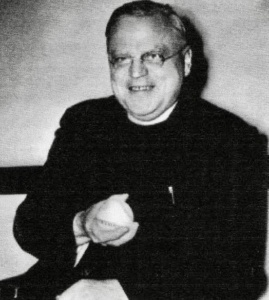
Allan Travers, the Jesuit priest who pitched one game in the Major Leagues. He lost 24-2.
He passed away on April 19, 1968, at the age of 75—also in Philadelphia.
Allan, who was studying at the seminary to be ordained as a Jesuit priest, was recruited on an emergency basis by the Detroit Tigers. He pitched a complete game against the Athletics in Philadelphia—a game he lost—collected a paycheck of $50, and never threw another pitch toward home plate again.
That appearance by Allan Travers as a pitcher took place on May 18, 1912. Today marks the 114th anniversary of that event.
Allan was subsequently ordained as a Jesuit priest.
The trouble had begun at Yankee Stadium on May 15, when the Tigers were visiting the Yankees.
One of the Yankee spectators, a man named Claude Lueker, shouted at Ty Cobb, calling him a “half-nigger”—a slur that, in that era rife with racism, constituted a tremendous insult. In response, Cobb climbed into the stands and physically assaulted Lueker, who had lost both of his hands in an industrial accident.
When Cobb was informed of Lueker’s disability, he exclaimed: “I don’t give a damn if he doesn’t have a head, because he’s a son of a bitch!”
The American League president, Ban Johnson, suspended Cobb indefinitely. The Tigers’ next series was scheduled for Philadelphia, where they were set to play as visitors against the Athletics. However, all the players—despite having very little personal affection for Ty Cobb—decided to go on strike in solidarity with him. Consequently, Johnson warned the Tigers’ owner, Frank Navin, that he would fine him five thousand dollars for every game the team failed to play.
To avoid the penalty, Navin ordered manager Hughie Jennings to scour Philadelphia for young men eager to make an appearance in the Major Leagues, paying them 25 dollars per game.
Among those recruited was Allan Travers, then 20, who was paid double—50 dollars—because he was to serve as the pitcher. He was a student at St. Joseph’s College, where he incidentally played the violin in the orchestra. And yes, he had indeed played baseball before.
That afternoon, young Travers became the Tigers’ starting pitcher, facing an audience of 15,201 spectators at Shibe Park in Philadelphia. He went up against the team that had won the World Series twice—in 1910 and 1911—and whose lineup featured Frank “Home Run” Baker, Eddie Collins, and Stuffy McInnis.
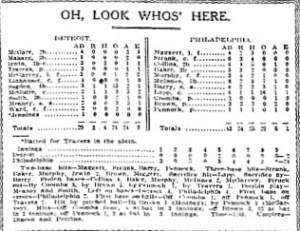
The box score of the game pitched by the Travers, the Jesuit priest.
Travers’s final stat line: 0-1 in a complete game; he allowed 26 hits, recorded 1 strikeout and 7 walks, surrendered 24 runs (14 earned), posted an ERA of 15.75, and faced 50 batters. He lost the game 24–2. This was the Tigers’ lineup, featuring their emergency squad: Jim Garr (4), Ed Irwin (5), Allan Travers (1), Dan McGarvey (7), Bill Leinhausen (8), Joe Sugden (3), Deacon McGuire (2), Vincent Maney (6), and Hap Ward (9).
The Athletics, naturally, fielded their regulars: Harl Maggert (8), Billy Haker (5), Eddie Collins (4), Frank “Home Run” Baker (7), Danny Murphy (9), John Phalem “Stuffy” McInnis (3), Jack Barry (6), Jack Lapp (2), and Jack Coombs (1).
Fame was a nuisance to Travers, given his religious duties, so he declined to grant interviews on the subject. It was not until 1962 that he agreed to speak with Red Smith, a sports journalist.
He revealed that the Tigers’ manager had tasked him with rounding up a group of young men to form the Detroit team’s roster—at a rate of $25 per head, per game.
Consequently, he went with the coaches to the corner of 23rd Street and Columbia Avenue, where they managed to enlist that handful of youngsters.
Regarding his performance as a pitcher, he told Smith: “I threw slow curves, because I don’t have a powerful fastball, and because the manager—Jennings—told me that those batters weren’t accustomed to that kind of pitch.”
Also playing for the Tigers that day were the manager, Jennings—then 43 years old—and coaches Joe Sugden (41) and Deacon McGuire (48). Incidentally, all three enjoyed brilliant careers as big leaguers.
The strike ended the very next day, when Johnson threatened to ban the entire roster from baseball.
Travers passed away at Mercy Hospital in Philadelphia in 1968, at the age of 75.
Thanks to life, which has given me so much, including a reader like you.
ATTENTION: You can read the archive of Juan Vené en La Pelota online at: El deporte vuelve a unirnos.
@juanvene5

(En Español)
Los Big Leaguers Alzados Hace 114 Años
Futuro Sacerdote Lanzó en la MLB Durante la Primera Huelga de Peloteros
Fue un Notable Educador Jesuita
Coral Gables, Florida (VIP-WIRE) – Asombroso el caso del cura jesuita pelotero de las Grandes Ligas. Era llamado Allan Travers, pitcher derecho, nacido el siete de mayo de 1892, en Philadelphia, Pennsylvania.
Murió el 19 de abril de 1968, a los 75 años, también en Filadelfia.
El pitcher, sacerdote y educador jesuíta, Allan Travers.
Allan, quien estudiaba en el seminario para ordenarse de sacerdote jesuita, fue reclutado de emergencia por los Tigres de Detroit, lanzó un juego completo frente a los Atléticos, en Philadelphia, lo perdió, cobró 50 dólares y más nunca tiró para home.
Esa aparición de Allan Travers como lanzador, ocurrió el 18 de mayo de 1912. Se cumplen hoy 114 años.
Allan fue ordenado sacerdote jesuita más tarde.
El problema había comenzado en Yankee Stadium, el 15 de mayo, cuando los Tigres visitaban a los Yankees.
Uno de los espectadores yankistas, llamado Claude Lueker, le gritó a Ty Cobb que era mitad negro (half-nigger), lo que, en esa época de tanto racismo, era un tremendo insulto. Por eso, Cobb se montó en las tribunas y golpeó a Lueker, quien había perdido las manos en un accidente laboral.
Cuando le informaron a Cobb de esa desventaja de Lueker, exclamó: “¡Poco me importa si no tiene cabeza, porque es un hijo de perra!”
El presidente de la Liga Americana, Ban Johnson, suspendió indefinidamente a Cobb. La siguiente serie de los Tigres era en Philadelphia, como visitantes de los Atléticos. Pero todos los jugadores, aun cuando querían muy poco a Ty Cobb, decidieron declararse en huelga en solidaridad con él.
Entonces, Johnson advirtió al propietario de los Tigres, Frank Navin, que lo multaría con cinco mil dólares cada vez que no jugaran.
Para evitar la sanción, Navin ordenó al mánager Hughie Jennings que buscara en Filadelfia jóvenes que quisieran aparecer en las Grandes Ligas y les pagaba 25 dólares por juego.
Entre los reclutados estuvo Allan Travers, entonces de 20 años, a quien le pagaron el doble, 50 dólares, porque sería el pitcher. Estudiaba en el St. Joseph’s College, donde, de paso, tocaba el violín en la orquesta. Y sí había jugado beisbol.
Esa tarde, el joven Travers se convirtió en el pitcher abridor de los Tigres, ante 15 mil 201 espectadores en el Shibe Park de Filadelfia. Enfrentó al equipo que había ganado dos veces la Serie Mundial, en 1910 y 1911, cuya alineación incluía a Frank (Home Run) Baker, Eddie Collins y Stuffy McInnis.
El récord de Travers: 0-1, en un juego completo, le conectaron 26 hits, 1 strikeout y 7 bases por bolas, permitió 24 carreras, 14 limpias, efectividad de 15.75 y enfrentó a 50 bateadores. Perdió 24-2.
Esta fue la alineación de los Tigres con su gente de emergencia: Jim Garr 4, Ed Irwin 5, Allan Travers 1, Dan McGarvey 7, Bill Leinhausen 8, Joe Sugdem 3, Deacon McGuire 2, Vicent Maney 6 y Hap Ward 9.
El box score de aquel juego, hace hoy 114 años.
Los Atléticos, desde luego, con sus regulares: Harl Maggert 8, Billy Haker 5, Eddie Collins 4, Frank (Home Run) Baker 7, Danny Murphy 9, John Phalem “Stuffy” McInnis 3, Jack Barry 6, Jack Lapp 2, Jack Coombs 1.
La fama molestaba a Travers, debido a sus labores religiosas, por lo que no concedía entrevistas al respecto. No fue hasta 1962 que aceptó hablar con Red Smith, un periodista deportivo.
Reveló que el mánager de los Tigres lo había encargado de reunir al grupo de jóvenes para que, a 25 dólares por cabeza en cada juego, formaran el roster del equipo de Detroit.
Por eso, fue con los coaches hasta la esquina de la calle 23 con la avenida Columbia, donde lograron comprometer al puñado de jovencitos.
Acerca de su actuación como lanzador, le dijo a Smith: “Tiré curvas lentas porque no tengo una recta poderosa y porque el mánager, Jennings, me dijo que eran bateadores poco acostumbrados a un lanzamiento así”.
Por los Tigres también jugaron esa vez el mánager, Jennings, entonces de 43 años, y los coaches Joe Sugden (41) y Deacon McGuire (48). Por cierto, los tres tuvieron brillantes carreras como big leaguers.
La huelga terminó al día siguiente, cuando Johnson amenazó con expulsar del beisbol a todo el roster.
Travers murió en el Hospital de la Misericordia de Filadelfia, en 1968, a los 75 años.
Gracias a la vida que me ha dado tanto, incluso un lector como tú.
ATENCIÓN: Puedes leer el archivo de Juan Vené en La Pelota en Internet si entras con: El deporte vuelve a unirnos.
@juanvene5